As is typical behavior, the United States first entered a sham diplomatic process in
the buildup to the war. This was nothing but a thin veneer intended for a Western
audience to counter the obvious impression that the United States is the sole
aggressor.
This fake diplomatic display would’ve been more effective if it hadn’t been for the
Omani foreign minister, Badr Al Busaidi, who had been mediating the talks, going
on CBS News’ “Face the Nation” on February 28 to tell the public how much Iran
was offering to avoid war.
Iran, Busaidi said, had offered even more restrictions on its civilian nuclear
programs. Most crucially, Iran promised it would not stockpile any nuclear material.
“This is something that is not in the old deal that was negotiated during President
Obama’s time,” Busaidi said. “This is something completely new. It really makes the
enrichment argument less relevant, because now we are talking about zero
stockpiling. And that is very, very important because if you cannot stockpile
material that is enriched, then there is no way you can actually create a bomb,
whether you enrich or don’t enrich.”
Iran also agreed to let the IAEA monitor its nuclear programs for “full verification.”
Trita Parsi of the Quincy Institute for Responsible Statecraft commented,
The Omani FM [foreign minister] going on CBS to reveal what has actually been
achieved in the negotiations is quite unprecedented. And what has been achieved is
significant—Trump can indeed declare victory. … it goes way beyond what Obama
achieved.
But everything indicates that Trump won’t take yes for an answer. That he will
start a war of choice very soon.
Which is probably why the Omani FM decided to go public. So that the
American people knew that peace was within reach when Trump instead opted for
war.
Just a few hours after Badr Al Busaidi’s appearance on CBS, Trump announced
“major combat operations” in Iran. That’s a euphemism for declaring war, but
technically the US Constitution only grants Congress the right to formally declare
war, which they haven’t done since 1941, so every president simply announces the
start of “major combat operations” to easily circumvent that pesky little document.
Contrary to popular opinion, Trump is in some ways a much more honest president
than his predecessors: “We have a thing called a war, or as they would rather say, a
‘military operation.’ It’s for legal reasons,” he recently explained. “I don’t need any
approvals. As a war [sic] you’re supposed to get approval from Congress. Something
like that.”
Amazingly, Defense Secretary Pete Hegseth later claimed that the United States
never abandoned negotiations and that they still hoped Iran would acquiesce to US
demands. The war, according to Hegseth, was merely a way to pressure the Iranians.
“We negotiate with bombs,” he said.
The lunatics at the Pentagon called this one “Operation EPIC FURY.”
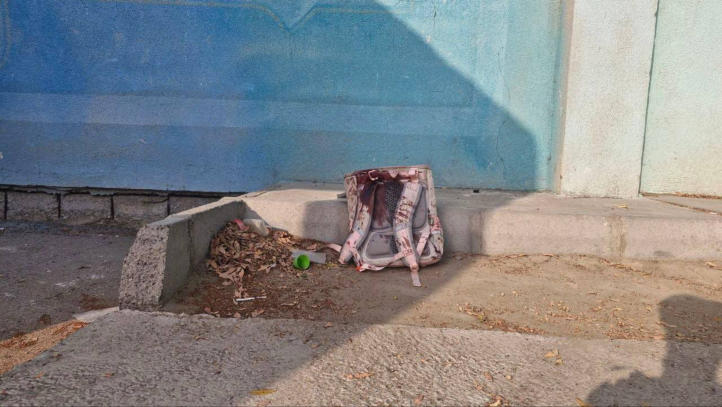
In the opening salvo of the war, the US fired a Tomahawk missile at a girls’
elementary school in the city of Minab, killing 168 little girls and 14 teachers.
A ‘liberated’ little girl’s bloodstained backpack (Minab, Iran. February 28, 2026)
When asked about it, Trump claimed Iran conducted the strike. But fragments
recovered at the site, with the DOD serial number and “Made in USA” markings still
legible, identify the cruise missile as a Tomahawk, which Iran does not have, nor
could they launch it even if they did. Beside the US, only Australia and Britain own
Tomahawk missiles.
Several hours after the massacre in Minab, dozens of teenage girls were killed in a
sports gymnasium in the city of Lamerd, killing at least 18. As reported by Drop Site
News:
The missile struck the middle of the roof, destroying a large part of the building.
The main court, small spectator stands, changing rooms, and a coach’s office were
all reduced to rubble.
Hossein Gholami, a 50-year-old elementary school teacher, was returning from
work when he heard the blast. His 16-year-old daughter, Zahra, was training in the
hall.
“I noticed a strange gathering of people at the corner of the street leading to the
sports hall,” Gholami told Drop Site. “The screaming was rising from a distance. A
colleague ran toward me, waving his arm, and said in a shaken voice: ‘Zahra, the
hall, there has been an explosion.’ I felt as though the ground had split beneath my
feet. Everything around me became hazy,” he said. “I ran immediately, and with
every step the columns of black smoke rose higher, while the smell of fire and
flames entered my nose with force.”
When he reached the site, he came upon a scene of horror. “The continuous
screaming of the injured mixed with the sounds of secondary explosions. The
ground was covered in debris and shattered glass. It was difficult to move with all
the rubble. […] The smell of blood and burns covered everything. … the survivors
were injured with fractures and burns from the shrapnel.”
Later, he learned that Zahra was among the dead. “Every time I close my eyes I
see her face, her smile, and I hear the sound of the explosion,” Gholami said.
Another father, Mir Dehdasht, described much the same scene after he ran to the
sports hall when a neighbor informed him of the attack: “The injured were bleeding
heavily, some had lost consciousness on the ground, others were screaming without
stopping. Their voices were deafening.” His 15-year-old daughter, Rabab Dehdasht,
was killed. “I felt completely helpless,” Mir said.
A third father, Farhad Za’eri, heard about the attack by phone. He rushed to the
sports hall to find rescue teams “bringing out the bodies one by one. … In that
moment, everything inside me was silent, and I was waiting for them to tell me
about my daughter Elahe.”
Elahe was only 16 years old. When her body was eventually brought out Farhad saw
she “was completely destroyed. It appears she was directly hit by the strike. The
lower part of her body was completely destroyed.”
“How can a father describe what he feels when he sees his child like this? All my
memories of her, her laugh, her training, her dreams, collapsed before my eyes in a
single moment.”
I know that Israel’s genocide, and in particular the Western media’s insistence on
using the phrase “war in Gaza,” has normalized the idea that war involves such
massacres. And it does, absolutely, to a certain extent, but not to this degree. Carpet
bombing countries is a choice. They are either choosing to bomb these targets or
choosing to bomb recklessly. And unfortunately, it’s a choice US soldiers are more
than happy to make:
On March 3, Common Dreams published a report titled: “US Commanders Want to
Make War With Iran as ‘Bloody’ as Possible to Bring About Biblical End Times,
Officers Report.” (Emphasis added by me):
In less than a week, the US and Israel’s war has rendered unfathomable suffering
upon the people of Iran. … But some US troops are being told the bloodletting is all
part of God’s plan.
…A combat-unit commander reportedly told noncommissioned officers (NCOs)
that the commander-in-chief was “anointed by Jesus to light the signal fire in Iran
to cause Armageddon and mark his return to Earth.”
The complaint, sent by one of those noncommissioned officers, was just one of
at least 110 similar reports received by the Military Religious Freedom Foundation
(MRFF) since Trump first launched strikes on Saturday.
…Under defense Secretary Pete Hegseth, an evangelical Christian who has said
the West must wage a “crusade” against Islam, Christian nationalist invocations in
the military have become commonplace.
Mikey Weinstein, the president and founder of MRFF and an Air Force veteran
who served in the White House of former President Ronald Reagan, told
independent journalist Jonathan Larsen that the group has been “inundated” with
complaints from NCOs since Saturday, which all have “one damn thing in freaking
common.”
“Our MRFF clients report the unrestricted euphoria of their commanders and
command chains as to how this new ‘biblically-sanctioned’ war is clearly the
undeniable sign of the expeditious approach of the fundamentalist Christian ‘End
Times’ as vividly described in the New Testament Book of Revelation,” Weinstein
said.
“Many of their commanders,” he added, “are especially delighted with how graphic
this battle will be, zeroing in on how bloody all of this must be in order to fulfill
and be in 100% accordance with fundamentalist Christian end-of-the-world
eschatology.”
…Larsen reported that the “complaints came from more than 40 different units
spread across at least 30 military installations,” and have involved commanders in
every branch of the US military.
One noncommissioned officer … said his commander “urged us to tell our
troops that this was ‘all part of God’s divine plan’ and he specifically referenced
numerous citations out of the Book of Revelation referring to Armageddon and the
imminent return of Jesus Christ.”
The NCO added that his commander “had a big grin on his face when he said all
of this, which made his message seem even more crazy.”
Besides schools and gymnasiums, the US and Israel have also been attacking
residential buildings, hospitals, clinics, news studios, and water desalination plants.
This follows the same playbook perfected by the US over decades to inflict
maximum devastation on the entire population. American generals first developed
this doctrine during World War II. About the bombing of Japan, General Curtis
LeMay famously said, “There are no innocent civilians, it is their government and
you are fighting a people, you are not trying to fight an armed force anymore—so it
doesn’t bother me so much to be killing the so-called innocent bystanders.”
The same playbook was used in Korea, Vietnam (with extensive chemical warfare),
Iraq, Yugoslavia, Afghanistan, and Libya.
Now we are seeing it in Iran. On March 1, the invaders carried out a “double tap” on
Niloofar Square in Tehran—a popular middle-class nightspot with cafés where
Muslims gathered to break the Ramadan fast. It opened with a small strike and
followed up with a larger attack to kill people that arrived to help.
One witness who survived the attack in Café Ahla recounted the story to a reporter:
“We saw blood was spraying everywhere. Someone’s hand had fallen on the floor, a
head had fallen on the floor,” they said. “There were scalps torn off, hands severed, a
few people were laying here all cut up and two people were martyred. … One of my
friends … was severed in half. Half of him was thrown to the side. … A piece of his
brain was thrown here on the floor.”
On March 7, when Trump was asked on Air Force One about the attacks on Iran’s
water infrastructure, he said: “They [Iranians] are among the most evil people ever
on Earth. They cut babies’ heads off. They chop women in half. What they did—take
a look at October 7th, take a look at what they’ve done over the last 47 years. So I
know nothing about a desalinization plant other than to say, if they’re complaining
about a desalinization plant—we complain that they shouldn’t be chopping babies’
heads off, okay?”
For the record, no babies were beheaded by Iran or Hamas. Nor are women chopped
in half. Also, Iran and Hamas are not the same: Iran is Shiite and Hamas is Sunni,
Iran is mainly Persian and Hamas is Arab. Saudi Arabia, which is Sunni and Arab, is
a regime that beheads people for mocking the Kingdom on social media and
sponsors al-Qaeda and ISIS with money and weapons they’ve purchased from the
US, but Trump doesn’t include them in his screed.
Later that same day, after Trump called Iranians “the most evil people on Earth,”
Israeli strikes targeted Iran’s oil facilities. In a piece published by Drop Site, Iranian
journalist Ariya Farahmand interviewed several Iranians about the attack:
Saghar, 24, lives with her parents and sister in a residential complex in
northeastern Tehran, perilously close to the Aghdasieh oil depot.
“The house shook, it truly shook. Far worse than an earthquake,” Saghar told
Drop Site News. (Saghar is a pseudonym; she requested anonymity to speak with
Drop Site News given the war.) “I remember the Tehran earthquake of May
2020—this was exponentially worse. The kitchen and living room windows
shattered instantly, and the chandelier swung violently like a pendulum. My
mother was at the sink washing dinner plates when the blast hit. The shockwave
threw her so hard she landed head-first on the floor.”
…“My sister and I were in the living room. My father was lying down nearby.
We rushed to my mother first, and my father slowly dragged himself over because
his leg prevented him from walking easily,” Saghar said in a trembling voice. Her
father, a combat veteran, had suffered a gunshot wound from the Iran-Iraq war in
the 1980s that left him severely impaired. “For the first few seconds, my mother
was completely dazed. We were paralyzed, not knowing what to do.”
They called emergency services and received triage instructions over the phone.
“They told us not to move her, fearing a critical fracture. After about 15 minutes,
each second dragging like a year, the paramedics arrived. Following an initial
assessment, they loaded her into an ambulance and rushed her to a nearby
hospital.”
…As soon as my mother was discharged and cleared by the doctors, we planned to
flee to Ramsar.”
Ramsar, located some 220 kilometers (136 miles) northwest of Tehran on the
Caspian Sea, has become something of a safe haven in the escalating war. Tens of
thousands of residents of Tehran and other cities have fled north to Mazandaran
seeking shelter from the bombardment.
“Since the war began, we stayed in Tehran under the assumption that a purely
residential complex wouldn’t be targeted,” she added. “We figured we were safe,
with no military or security installations nearby. We never imagined a fuel depot
nestled next to a civilian neighborhood would be bombed.”
When they returned to their apartment to pack, some nine hours after taking
their mother to hospital, they found it blackened from the oil fires raging nearby.
“Everything was coated in soot,” Saghar said. “Our white refrigerator was entirely
black. If you ran your finger across any surface, it came away stained black.”
For two grueling hours, Saghar and her sister scrubbed surfaces and wiped
down appliances. Wet rags became instantly soaked with heavy, black sludge as
they tried to clean the thick, greasy layer of airborne crude. “We went through rolls
of paper towels and bottles of detergent, but the oily film just smeared before it
lifted,” she said. “By the time we finally packed our bags and locked the door, our
fingernails were caked in chemical grime, and our lungs were burning just from
breathing inside our own living room.”
The oil fires spread toxic hydrocarbon compounds and sulfur and nitrogen oxides in
the air. When it rained that night, it resulted in acidic “black rain” that could cause
chemical skin burns and lung damage from the fumes.
Sara, 36, had been sheltering for a few days with her husband at their home in the
Teheran neighborhood of Ekbatan, far from the targeted oil facilities. “My husband
and I had planned to go grocery shopping on Sunday morning—meat, fruit, basic
essentials. We’d been cooped up for two or three days,” Sara, who only gave her
first name, told Drop Site. “When I saw the air on Sunday morning, I told him it
wasn’t safe to go outside. We postponed it. By evening, the soot in our
neighborhood seemed to have cleared, and we could see patches of blue sky, even
though we could see other parts of the city were still smothered in smoke. We
decided to make a run for it.”
Sara and her husband, Mehdi, walked to the grocery store about five six
minutes away. “Our breathing became incredibly heavy. We felt like we had been
doing grueling manual labor after walking for only five minutes,” she said. “We
bought face masks on the spot and wore them the entire way back.”
Sitting in her two-bedroom apartment with her husband, Sara displayed her
hands that were inflamed and covered in hives. “I have an old allergy that used to
bother me, but it had been dormant for a long time. A few hours after getting back,
my hands started itching intensely, turned red, and broke out in these hives,” she
said. Her forearms were scratched raw while Mehdi suffered from labored
breathing and a severe headache.
“Despite the blue sky, it felt like acid had been poured down our throats,” she
said.
While Iranians will suffer the immediate environmental impacts, don’t think the
rest of the world escapes the long-term ecological consequences. On March 21, The
Guardian warned:
The US-Israel war on Iran is a disaster for the climate, according to an analysis that
finds it is draining the global carbon budget faster than 84 countries combined.
…the first analysis of the climate cost has found the conflict led to 5m tonnes of
greenhouse gas emissions in its first 14 days.
…“Every missile strike is another downpayment on a hotter, more unstable
planet, and none of it makes anyone safer,” said Patrick Bigger, a research director
at the Climate and Community Institute and a co-author of the analysis.
…Destroyed buildings constitute the largest element of the estimated carbon
cost. Based on reports by the Iranian Red Crescent humanitarian ogranisation that
about 20,000 civilian buildings have been damaged by the conflict, the analysis
estimates the total emissions from this sector to be 2.4m tonnes of CO2 equivalent
(tCO2e).
…Fred Otu-Larbi, the study’s lead author, from the University of Energy and
Natural resources in Ghana, said: … [“]Burning up the annual emissions of Iceland
in two weeks is something we really cannot afford.”
Retired US Colonel Lawrence Wilkerson—former Chief of Staff to Colin Powell,
turned critic of the Iraq War—recently told Democracy Now!:
This administration has committed more war crimes in the last few days than I
think any country since Adolf Hitler committed. And that is an incredible
condemnation of this entire process. We have bombed civilians relentlessly, we
have bombed a school, we have bombed a hospital. We have struck facilities in the
nature of Iran’s oil capacity, that is now putting black poison all over ten plus
million people.
And we are essentially not bombing ballistic missile sites and bombing war
materiel, we’re bombing people! We took a lesson from the IDF, if you will. We are
bombing people, as incidentally they are still doing in Gaza and doing now in
Lebanon. ... These are all war crimes, and one wishes with fond hope that some day
we might be called for the bar of justice and have to account for these war crimes.
He also dispelled the myths that the Iranians want a US invasion to “liberate” them,
and that Trump is capable of carrying out regime change:
This is a country as big as western Europe, with 93 million people—probably 90
million of whom will fight us to the bitter death—who live in terrain that almost
killed Alexander the Great, it is entirely inhospitable to military operations, and
Trump is actually talking about putting ground forces there. And the only way he
will be able to claim any nature of victory is to do that. Only that will be the end of
the Empire’s presence in the Levant and the Middle East in general, because we
will not be able to sustain that economically, physically, we do not have the soldiers
or marines to do that. But that’s what he’s talking about. This is pure nonsense.
Even the Iranians who were foolish, corrupt, or desperate enough to welcome a US-
led regime change have now changed their minds. The Financial Times interviewed
several of them in early March. “I never thought I’d say this,” one woman said, “but
if someone from within the regime becomes a real reformer, why not? In the end, we
just want peace and welfare.”
Another woman, “Marjan, a housewife,” was overjoyed when the war started
because “She had believed it would usher in the regime’s collapse.” But when she
saw what American hollow-point democracy looks like—carpet bombing
neighborhoods, laser-guided liberation delivered via B-2 stealth bombers—she
quickly became disillusioned: “Now I wonder, even if the Islamic Republic falls,
what will we inherit: a land in ruins?” she asked.
Of course, the Americans were never interested in liberation. The famous left-wing
scholar Tariq Ali wrote early in the war that he’d “heard from an Iranian friend that
her partner in Tehran has sent her a message. He is a leftist and is telling her that
the US/Israelis are targeting a number of known leftists homes in Teheran and
elsewhere in an attempt to make sure there’s no opposition to their favored
candidate once they destroy the regime.”
This, in case you’re wondering, is also a part of the playbook. In Indonesia, for
example, the US helped the extremist Suharto come to power by funding and
arming his troops. The Americans provided him with lists of suspected leftists. What
followed was one of the bloodiest coups of the Cold War, with 1 million leftists
massacred—ranging from communist politicians to feminists and simple trade
unionists or even peasants who leaned socialist. Internally, in a top-secret report,
the CIA said the killings “rank as one of the worst mass murders of the 20th
century.” The US would continue to support Suharto and his murderous
dictatorship until the collapse of his regime in 1998.
Again, this playbook has been perfected over decades.
It seems that the one saving grace we have is the arrogant incompetence of this
administration. Nothing so far has gone to plan.
In July of last year, the department of government efficiency (DOGE) axed key oil
and gas experts from the State Department. One of their jobs is to model worst-case
scenarios for the oil market, how geopolitical conflicts could disrupt it (by closing
the Strait of Hormuz, let’s say), and how to navigate such crises. “I’m sure Secretary
Rubio wishes he had that expertise available today,” Geoffrey Pyatt, a former
assistant secretary of state for energy resources, said.
Then, in September of 2025, the US Navy decommissioned the last of its four mine
countermeasure ships, the USS Devastator. The other three—the USS Dextrous, the
USS Gladiator, and the USS Sentry—were all retired earlier that same year. Yes, in
their infinite genius the Trump administration got rid off their minesweepers before
launching a war that would obviously close the Strait of Hormuz via Iranian sea
mines. Incroyable.
Furthermore, the timing of this war couldn’t have been worse. It is springtime in the
northern hemisphere which means farmers are now planting their crops. They need
fertilizer, and currently most fertilizers are nitrogen-based, a key ingredient in
nitrogen fertilizer is ammonia, and ammonia is made with natural gas. Ergo, the
price of fertilizer is spiking along with energy just as farmers are planting their
crops. That, in turn, will increase food costs.
But that’s only the beginning. Fuel is also used for tractors and irrigation systems,
and to transport the produce via truck to supermarkets, where it needs to be
refrigerated and packaged in plastic, which is made from a byproduct of
petrochemicals.
In short, inflation will worsen. As it already has in weaker countries. In India, gas
shortages have caused partial closures of businesses, putting hundreds of thousands
out of work. Street-food vendors are hit particularly hard, having to either shutter
their businesses or shift to cooking with wood in an already air-polluted country. In
Sri Lanka, the government added extra holidays to the calendar as they were forced
to start rationing fuel. Fuel prices have increased 33 percent for households and
with it the cost of commodities and public transportation.
Bangladesh has restricted electricity use for government buildings, also added extra
holidays, and shuttered schools to hold classes online. Pakistan has done the same
by shutting down its schools and colleges given that 90% of its energy is imported
from the Persian Gulf. They have begun a quota system to distribute fuel.
Inflation has also hit Nepal, which is also facing a shortage of cooking gas due to the
war. Even worse, nearly a quarter of Nepal’s GDP comes from overseas
workers—mainly 1.2 million Nepalis that work in the Persian Gulf, that send
remittances back home. This is a massive crisis for Nepal. Though I’m sure
ExxonMobil will welcome the increase in oil prices.
The pro-capitalist economist Milton Freedman once said that “Inflation is the one
form of taxation which can be imposed without any legislative action.”
As for the regime change bit, that also didn’t seem to go as planned.
A few days after Venezuelan President Nicolás Maduro was kidnapped by the US,
Ayatollah Khamenei visited the shrine of his predecessor, Ayatollah Khomeini, who
had died at the age of 89, the same age Khamenei was now. When the war started,
Khamenei didn’t run; instead he martyred himself. This seems to have come as a
surprise and a disappointment to the Americans.
The New York Times tried their best to make the story sound heroic. The CIA and
Israel had been “tracking him for months,” “gaining more confidence about his
locations and his patterns,” the paper boasted. “People briefed on the operation
described it as a product of good intelligence and months of preparations.”
“During that 12-day war, the United States learned even more about how the
supreme leader and the Islamic Revolutionary Guard Corps communicated and
moved while under pressure,” the piece continued. “The United States used that
knowledge to hone its ability to track Ayatollah Khamenei and predict his
movements.”
That all sounds far more impressive than what actually happened. Khamenei was in
his office, having refused the advice to flee. He was killed on the first day of the war.
The fact that assassinating the leader of a UN-member country is illegal or immoral
is not mentioned by the Times.
Far from this causing on the collapse of the Iranian government, Khamenei’s son,
Mojtaba, was elected to replace his father by the Assembly of Experts—a body of 88
members elected by the public who in turn elect the Supreme Leader.
Mojtaba Khamenei’s wife, Zahra Adel, and son, Mohamed Amin, as well as his
mother, Mansoureh, and obviously his father Ali, plus one of his sisters and her
husband, were all killed on February 28. It’s unlikely, then, that he will bend the
knee to the Americans. Some speculative reporting suggests that Mojtaba might not
share his father’s opposition to nuclear weapons. I think it’d be foolish not to pursue
them now. The US and Israel have proven that they can’t be reasoned with
diplomatically. And besides, do you see us invading North Korea?
Not exactly a good thing for the world. A peace kept only by mutually assured
destruction is no peace at all. But it might be the only deterrent from the United
States.
The Trump administration has also been caught off guard when Iran attacked US
bases in the region and closed the Strait of Hormuz, despite having warned for
months that they’d do just that in case they were attacked. The IRGC even
conducted training exercises last month in the Strait to practice shutting it down,
while Ayatollah Khamenei wrote on Twitter: “The Americans should know if they
start a war, this time it will be a regional war.”
A report from CNN on March 13 exposed that “The Pentagon and National Security
Council significantly underestimated Iran’s willingness to close the Strait of Hormuz
in response to US military strikes while planning the ongoing operation, according
to multiple sources familiar with the matter.
“President Donald Trump’s national security team failed to fully account for the
potential consequences of what some officials have described as a worst-case
scenario now facing the administration, the sources said.”
According to the Wall Street Journal, “Trump acknowledged the risk” of Iran
blocking the Strait of Hormuz but “told his team that Tehran would likely capitulate
before closing the strait—and even if Iran tried, the US military could handle it.”
The US also underestimated Iran’s willingness and capability to destroy US military
bases in the region. After Washington ordered base personnel to abandon their
posts and check in to civilian hotels, Iran began bombing those hotels in targeted
strikes. It seems that also wasn’t anticipated.
These are fundamentally mistakes of hubris, and they are endemic to the arrogance
of empires. In 2002, the US military conducted the then most expensive war game
in its history. It was called the Millennium Challenge. The “red team” was modeled
on Iran’s capabilities and was led by Lt. Gen. Van Riper.
It was an easy victory for the red team. Using asymmetrical warfare, the “Iranians”
managed to sink most of the American fleet. Van Riper used old-school
communication methods. Sometimes a soldier would hand deliver messages by
motorcycle, or they would use light signals from the minarets of mosques. This
prevented the US team from intercepting their communications. Had it not been an
exercise, 20,000 US soldiers would’ve been killed. “Sir, Van Ripper just slimed all of
the ships,” General Gary Luck told his superior. The blue team leader admitted that
the red team “sunk my damn navy.”
Humiliated, the US commanders simply “refloated” the blue team’s fleet and placed
restrictions on the red team, ensuring they would lose. They were no longer allowed,
for instance, to hide their missile launch sites in caves. US military leaders assumed
that in the near-future they would have the technology to detect the missile launch
sites.
In today’s real war, the US has not been able to destroy all of Iran’s missile
launchers because a lot of them are hidden. Go figure.
The red team was simply forbidden from shooting down US aircraft and told to
move its anti-air defenses because the US would probably know where the air
defenses were stationed in the future.
When Van Riper said he would simply use chemical weapons if his regime was
collapsing anyway, he was told, “You are playing out of character.” While that’s
probably true, it’s not exactly something you can say to your actual adversary on the
battlefield.
Van Riper resigned in protest. “It simply became a scripted exercise,” he said. “They
had a predetermined end, and they scripted the exercise to that end.”
The military’s own report of the Millennium Challenge would not be made public for
another ten years, but it concluded the same thing:
As the exercise progressed, the OPFOR free-play was eventually constrained to the
point where the end state was scripted. This scripting ensured a blue team
operational victory and established conditions in the exercise for transition
operations.
Another war game from 2012 suggested Americans still don’t learn lessons. Once
again, the Americans got creamed. The after-action report noted that “the American
teams were surprised by the retaliation that their strikes triggered from the Iran
teams” and “assumed that Iranian rhetoric would not translate into action, and …
saw the Iranian reaction as excessive when the Iran teams chose to back up their
words with corresponding actions.” Sound familiar?
“They weren’t supposed to go after all these other countries in the Middle East,”
Trump told a press conference recently. “So they hit Qatar, Saudi Arabia, UAE,
Bahrain, Kuwait. Nobody expected that. We were shocked … you know, they fought
back! They could’ve yielded.”
The Americans clearly expected this to be a cakewalk. The reality is that they can’t
carry out regime change in Iran, thankfully. But they can kill immense numbers of
people and possibly reduce much of the country to rubble.
So why have they embarked on this doomed kamikaze mission? Apparently
someone got in Trump’s ear and convinced him to make history. On February 20,
eight days before the war, Drop Site reported that “Trump has repeatedly opined in
private about his desire to go down in history as the president who ‘changed the
Iranian regime’ that has remained in power since the 1979 Islamic revolution.
“Sources with knowledge of internal White House deliberations told Drop Site that
Trump is emboldened by what he sees as a phenomenal success in his Venezuela
strategy—issuing sweeping demands for capitulation under threat of removing the
ruling government.”
So who might’ve gotten into his ear? It’s certainly not a short list. There are a myriad
of interests that benefit from war and all for their own reasons. (The forces arguing
for peace, meanwhile, are negligible; no one makes buckets of money from peace).
The truth is that all those forces converged to pressure Trump into launching the
conflict. He is, after all, famously easy to manipulate.
We don’t know exactly what happened—as George Bush told us with his
administration, “I’ll be long gone before some smart person ever figures out what
happened inside this Oval Office,” and the same is true here—but we can make some
educated guesses based on the puzzle pieces we have.
Firstly there are the Israelis. Benjamin Netanyahu has long tried to convince US
leaders to start a regime change war in Iran. He even tried to manipulate Obama
into doing it, and was almost successful. Trump likes the Israelis because they flatter
him and Zionists give him money. Plus, right-wing Christian Evangelicals makeup a
significant portion of his base.
On March 6, the Wall Street Journal reported that Republican Senator Lindsey
Graham, one of the most fanatic Zionists in the US Congress and a long-time Trump
ally, instructed Benjamin Netanyahu on how to convince Trump to start the war:
To help make the case on Iran, Graham traveled several times to Israel in recent
weeks, meeting with members of the country’s intelligence agency. “They tell me
things our own government won’t tell me,” he said. He spoke with Israeli Prime
Minister Benjamin Netanyahu, coaching him on how to lobby the president for
action. Netanyahu showed the president intelligence that persuaded Trump to go
ahead, Graham said.
Another push came from the Saudis. Their feud with Iran also dates back to the ’79
revolution. Iran rejected the legitimacy of monarchies and undermined Saudi
Arabia’s image as leader of the Muslim world. Much like Saddam Hussein, the Saudi
dynasty also wanted to ensure the Islamic revolution failed so it wouldn’t inspire
their own populations.
During Trump’s first term, the Saudis spoiled him with money. They would hire
entire floors of Trump’s hotels without anybody actually staying in the rooms. And
they invested $2 billion in the private equity firm of Trump’s son-in-law Jared
Kushner, who served as White House advisor and helped broker an arms deal with
the Kingdom worth $110 billion. The committee that manages Saudi Arabia’s Public
Investment Fund (PIF) initially rejected the investment in Kushner’s firm, but
Crown Prince Mohammed bin Salman personally overruled that decision.
As part of the deal, the Saudi PIF pays Kushner $25 million dollars annually.
Now in his second term, Trump sent Kushner along with Middle East envoy Steve
Witkoff to the aforementioned negotiations with Iran. When Kushner was asked on
60 Minutes last year about potential conflicts of interests with the Saudis, he said:
“What people call conflicts of interests, Steve [Witkoff] and I call experience and
trusted relationships that we have throughout the world.”
Last January, the Saudi PIF financed a $7 billion property development deal with
the Trump Organization—enabling a project to build a Trump-themed hotel, a golf
course, and 500 “Trump mansions,” priced between $6.7 million and $24 million, in
the Saudi city of Diriyah. That is on top of the $10 billion in residential projects in
Jeddah that the Saudis gave Eric Trump at the moment of Donald’s reelection.
On February 28, the Washington Post reported: “Push from Saudis, Israel helped
move Trump to attack Iran.”
“Saudi Crown Prince Mohammed bin Salman made multiple private phone calls to
Trump over the past month advocating a US attack,” the article said. “The Saudi
leader warned that Iran would come away stronger … if the United States did not
strike now. … The attack came despite US intelligence assessments that Iran’s forces
were unlikely to pose an immediate threat to the US mainland within the next
decade.”
According to The Times of Israel, Kushner told Trump the Iranians were not
negotiating in good faith (which we know is false thanks to the Omani mediator
going on CBS). “These guys were not looking to make a quick deal,” Kushner
recounted to Trump. “They’re basically playing games.”
On March 1, Trump said Iran “could have made a deal. They should’ve done it
sooner. They played too cute.”
“Based on what Steve [Witkoff] and Jared [Kushner] and Pete [Hegseth] and others
were telling me, … the situation was very quickly approaching a point of no return,”
Trump said at a March 9 press conference. “They were going to attack us.”
And last but certainly not least there is the military-industrial complex. Curiously,
I’ve read many left-wing pieces about Israel and Saudi Arabia pushing Trump into
war but very little about America’s own war machine, which is odd because it’s by
far the most important.
After the Second World War, the United States’ imperial ambitions expanded
enormously. For the first time in its history, the end of the war did not coincide with
the demobilization of its military. The reasons for this were twofold. Firstly, the
Great Depression had exposed the flaws in private industry, which proved utterly
incapable of fixing its own economic collapse. State intervention proved a viable
solution: If the private sector can’t meet people’s needs and won’t hire people to
solve the unemployment crisis, then the government will do it.
This even included artists. Hundreds of painters, sculptors, actors, and singers, were
hired by the federal government and sent throughout the country to perform and
teach introductory classes for their professions. It was a redistribution of culture
unlike anything before or after in the United States. It was hugely popular and the
artists all had secure employment. Had these kinds of programs (and broader
nationalization of other industries) been allowed to grow, it would’ve pulled the
United States out of its economic crisis. Congress, however, blocked Roosevelt from
expanding these programs to the scale they needed to be.
What finally pulled the US out of its crisis was the Second World War, the biggest
federal employment program in US history with no objections from Congress. Half
of America’s unemployed were conscripted into the military and the other half were
sent into factories to make the bullets, the bombs, the uniforms, the ships, et cetera.
To produce the “arsenal of democracy,” as Roosevelt put it. And thus, the US war
industry was born.
During the Second World War, US planners, in conjunction with Wall Street
businessmen, concluded that in order to counter the threat posed to American
capitalism by the labor movement, the United States would have to expand its
economy to new markets. They inadvertently validated the theory of Vladimir Lenin
put forward in his book Imperialism: The Highest Stage of Capitalism, wherein he
argued that once capitalism becomes “overripe” it must seek to dominate foreign
markets in order to survive.
The Council on Foreign Relations, sometimes called “Wall Street’s think-tank”
because it staffs State Department planners as well as leaders of private industry,
made extensive post-war plans during WWII for what can only be described as
world domination. The documents are explicit: “The foremost requirement of the
United States in a world in which it proposes to hold unquestioned power is the
rapid fulfillment of a program of complete armament” as well as “coordination and
cooperation of the United States with other countries to secure the limitation of any
exercise of sovereignty by foreign nations that constitutes a threat to the minimum
world area essential for the security and economic prosperity of the United States.”
Another document recommends: “The United States must cultivate a world view
toward world settlement after this war, which will enable us to impose our own
terms, amounting perhaps to a Pax Americana. The United States must dominate
areas strategically necessary for world control.”
The documents go on like that, but you get the flavor. One member of the Council,
Winfield Riefler, said the plans were intended to “discover what ‘elbow room’ the
American economy needed in order to survive without major readjustments.” The
type of readjustments he meant were those proposed by the Left which would’ve
made imperialism unnecessary and infinite capital accumulation by the bourgeoisie
impossible by creating a democratic (socialist) economy geared towards meeting
people’s needs and not obscene profit for the rich.
In order to preserve this system, “without major readjustments,” the United States
would also have to keep its federal employment programs to prevent another
economic collapse. But in a society that worships the so-called free market there was
only one jobs program that could be kept in place politically: the military. As the
State Department would embark on its quest for “world control,” they would
guarantee a market for the private arms industry, which in turn would get its
resources cheaply from the soon-to-be-established pseudo-colonies.
In 1961, President Dwight Eisenhower coined the name for this system in his
farewell address:
Until the latest of our world conflicts, the United States had no armaments
industry. American makers of plowshares could, with time and as required, make
swords as well. But now … we have been compelled to create a permanent
armaments industry of vast proportions. Added to this, three and a half million
men and women are directly engaged in the defense establishment. We annually
spend on military security more than the net income of all United States
corporations.
This conjunction of an immense military establishment and a large arms
industry is new in the American experience. The total influence—economic,
political, even spiritual—is felt in every city, every State house, every office of the
Federal government. … We must not fail to comprehend its grave implications. Our
toil, resources and livelihood are all involved; so is the very structure of our
society.
In the councils of government, we must guard against the acquisition of
unwarranted influence, whether sought or unsought, by the military-industrial
complex. The potential for the disastrous rise of misplaced power exists and will
persist.
This unholy alliance of private American capital and a violent megalomanic state is
why America is almost constantly at war. And Iran is only the latest victim.
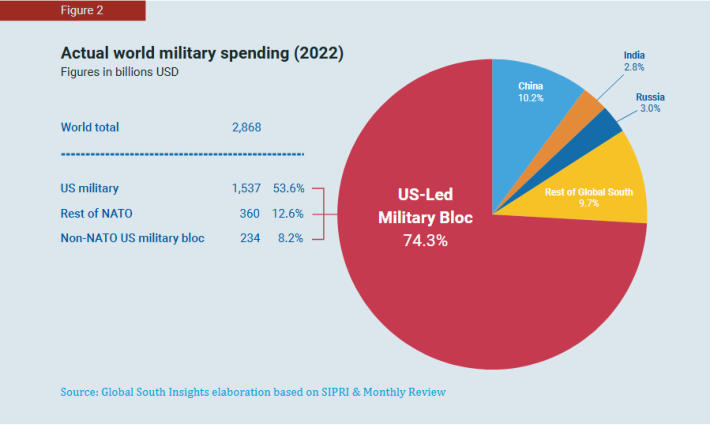
According to a 2024 study by the Tricontinental: Institute for Social Research, “the
US controls, through NATO and other means, an astounding 74.3% of all military
spending worldwide.” That amounts to over $2 trillion. The US doesn’t spend that
money for fun.
(From the Tricontinental’s study, Hyper Imperialism: A Dangerous Decadent New Stage)
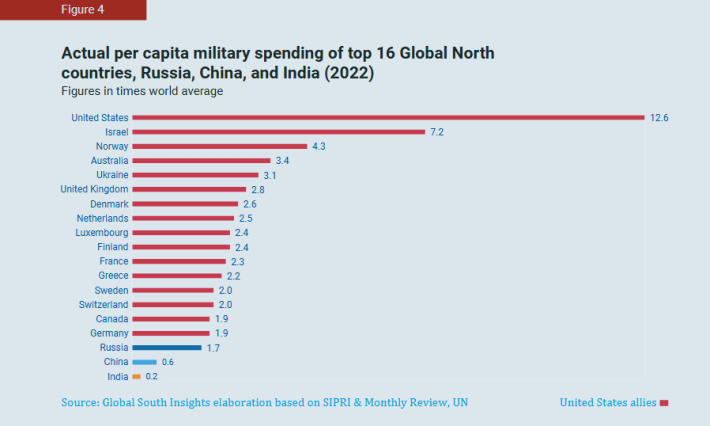
Not only that, but the West spends more on weaponry per capita than their three
largest competitors:
(Ibid)
One government official recently told The Intercept that the financial costs of the
Iran War could be in the trillions. “My kids’ kids, and probably their kids, are going
to be paying for this,” they said. The Intercept left the obvious question untouched:
paying whom? Where is all that tax-payer money going to go? To the weapons
industry, of course! The Iraq War cost taxpayers $8 trillion dollars, but that was
decades ago! We need fresh corpses to feed the war machine.
By the way, to keep these numbers in perspective, always remember: one million
seconds is twelve days; one billion seconds is thirty-one years; and a trillion seconds
is 31,688 years. These are ungodly sums of money we are talking about. That
could’ve easily been spent on healthcare, fixing roads and building bridges,
providing housing for the poor, or transitioning to clean energy sources. Instead
that money was used to realize the dystopian fantasies of decrepit Washington
politicians who yearn to smell the burning flesh of Muslim children.
Quite an empire.
The Iranians will, of course, not be the last victims of this system. In fact, this
administration has already gone on something of a murder-spree. Since the start of
Trump’s second term, the US has bombed people in Somalia, Iraq, Yemen, Iran,
Syria, Nigeria, and Venezuela, as well as 163 civilians in the Caribbean Sea. Those
strikes have continued even after the kidnapping of President Maduro, with very
little media attention. The latest happened on March 25, killing four people. Two
other strikes—one on March 8 and another on March 19, killing six and two,
respectively—happened during the current Iran War. This mass murder machine
operates without pause on several continents simultaneously.
Besides the air strikes, the US also conducts various military operations around the
world through various arcane programs and legal loopholes. For instance, buried
within Title 10 of the United States Code, section 127e allows US commandos—Army
Green Berets, Navy SEALs, and Marine Raiders—to aid foreign forces on US-
directed missions. This means that US forces can carry out US missions that are
officially conducted by an allied country’s military.
An investigation by the excellent journalist Nick Turse for The Intercept has
documented twenty-three 127e programs launched under Trump, including in
Afghanistan, Central African Republic, Cameroon, Ecuador, Egypt, Kenya, Lebanon,
Libya, Mali, Niger, North Korea, Pakistan, the Philippines, Tunisia, and an
undisclosed country in the Indo-Pacific. Many of them became known after they
went awry. In North Korea, for instance, SEAL Team 6 snuck on shore with the
intention of planting surveillance equipment. But their small “stealth” submarine
was spotted by a couple of fishermen.
The New York Times described what happened next:
A man from the North Korean boat splashed into the sea. … As the shore team
watched the North Korean in the water, the senior enlisted SEAL at the shore chose
a course of action. He wordlessly centered his rifle and fired. The other SEALs
instinctively did the same.
If the SEALs were unsure whether the mission had been compromised before
they fired, they had no doubt afterward. The plan required the SEALs to abort
immediately if they encountered anyone. North Korean security forces could be
coming. There was no time to plant the device.
The shore team swam to the boat to make sure that all the North Koreans were
dead. They found no guns or uniforms. Evidence suggested that the crew, which
people briefed on the mission said numbered two or three people, had been
civilians diving for shellfish. All were dead, including the man in the water.
Officials familiar with the mission said the SEALs pulled the bodies into the
water to hide them from the North Korean authorities. One added that the SEALs
punctured the boat crew’s lungs with knives to make sure their bodies would sink.
While Americans never have to worry about something like this happening to them,
the US government has decided that its vendetta against non-allied governments
condemns North Korean fishermen to possibly getting killed whenever a gaggle of
burger-eating Yankees toddle onto their shore and oafishly forget to hide their
submarine, all because Washington bureaucrats will not rest until privacy is dead
and the NSA can read Kim Jung Un’s emails. God, I hate this arrogant empire so
much.
Kathrine Yon Ebright from the Brennan Center’s Liberty and National Security
Program told Nick Turse: “During the global war on terror, the Department of
Defense built out its capacity, and legal authorities, to operate ‘by, with, and
through’ foreign militaries and paramilitaries. These smaller-scale, unauthorized
hostilities through or alongside foreign partners may seem quaint compared to the
Iran War and other recent public and persistent hostilities, but for years they
deepened the perception that the president may use force whenever and wherever
he pleases, even without specific congressional authorization.”
It’s is certainly a power that Donald Trump enjoys exercising. After the US bombed
Iran’s Kharg Island, and “totally demolished” much of the oil stored there, at least
according to Trump, he mused about attacking it again, saying, “We might hit it a
few more times just for fun.”
It’s been reported that Trump is often shown a highlight reel by members of his
cabinet of explosions to showcase the military’s “successes” in Iran.
Finally, and most distressingly, Trump is also looking to destroy Cuba. “You know,
all my life I’ve been hearing about the United States and Cuba. ‘When will the
United States do it?’ I do believe I’ll be the honor of—having the honor of taking
Cuba. That’d be good, that’s a big honor,” Trump told White House reporters last
month. “Taking Cuba?” one reporter asked. “Taking Cuba, in some form, yeah.
Taking Cuba,” Trump said. “I mean, whether I free it, take it; I think I can do
whatever I want with it, if you want to know the truth. A very weakened nation right
now.”
And why is it a weakened nation? Because the United States has maintained a
suffocating blockade on the island’s entire economy for the past 64 years. (In case
anybody cares, this is also illegal under international law.) In 2016, a Cuban
government report for the United Nations estimated the damage done to their
economy to be $753.688 billion.
Besides this criminal blockade, the United States has also supported numerous
terrorist attacks against Cuba. To name just one example, the CIA poisoned crops
and livestock multiple times to cause epidemics on the island. In 1971, Havana was
forced to cull half a million pigs after an outbreak of swine fever caused by US
terrorists. According to the Cuban government, within a period of “three years, five
serious diseases and epidemics have struck Cuban livestock, crops and people.
These are swine fever, blue mold (tobacco), red hot (sugar cane), hemorrhagic
dengue and conjunctivitis. These calamities have caused considerable material and
human damage.”
One of the most notorious anti-Castro terrorist groups which carried out at least 55
attacks, most of them bombings, was called Omega 7. The group publicly
assassinated Cuban diplomat Felix Garcia Rodriguez in Queens, New York—the first
time a United Nations official was killed. The founder, Eduardo Arocena, was
eventually convicted in a Manhattan court. During his trial, Arocena confessed to
receiving training from the CIA and that the agency sent him “to take certain germs
and to introduce them into Cuba so that they could be used against Soviet and
against the Cuban economy.”
After the attack on Venezuela last January, I warned that Washington planners
likely intended to make Cuba the next target. For the Empire, the goal is world
domination. Since Cuba doesn’t have its own oil resources, it relies on
imports—mainly from Venezuela, the other revolutionary government in Latin
America.
It didn’t even take a full month. On January 29, Trump unveiled an executive order
“to establish a tariff system”:
Under this system, an additional ad valorem duty may be imposed … [on] a foreign
country that directly or indirectly sells or otherwise provides oil to Cuba.
Without fuel, the Cuban power grid experienced outages, with the first nationwide
blackout occurring on March 16. Transportation and garbage trucks could no longer
run, meaning stores ran empty and trash piled up on the street; hospitals could no
longer perform surgeries and with only intermittent backup power, doctors would
sprint to manually ventilate children on breathing machines; dialysis machines
could no longer be powered putting roughly 3,000 people who need dialysis
treatment to survive on death’s door; and without gas many families struggled to
cook their food, having to rely on kerosine heaters which are hazardous to one’s
health.
Cuban Journalist and filmmaker Daniel Montero told Democracy Now! from
Havana,
We understand what this oil embargo means and what it has always meant. What
sanctions have always meant. This is regime change through starvation. That is
what they’re trying to do. And right now with the oil blockade, conditions are
worse than they ever have been. So, you know, as a Cuban, as someone living here,
all of my family is here, it is absolutely outrageous to listen to, you know, Donald
Trump and the administration in the United States, saying that they're trying to
help Cuba, they're trying to liberate Cuba.
“Sanctions are literally killing people right now,” he added. “The conditions are so
bad. And this has everything, absolutely everything to do with what the US is doing
to my country.”
I had planned to talk more about Cuba in this piece, but I had too much important
to say about Iran. We’ll have to save it for another time.
Netanyahu likes to remind people that Iran calls “Israel the Little Satan, to
distinguish it clearly from the country that has always been and will always be the
Great Satan—the United States of America.” A little reminder to the rest of us to buy
two crucifixes; a little one and a big one.
April 3 2026